Pages

Showing posts with label Download. Show all posts

Friday, 25 October 2013

Lamborghini-Veneno

Lamborghini-Veneno

The Lamborghini Veneno is set to make its video game debut in the upcoming Need for Speed Rivals game. The following trailer video for the upcoming game set for a release on November 19th showcases the $4 million Veneno in all its computer generated glory!
With just four units of the Lamborghini Veneno being produced, and just three of those going to customers, it’s inevitable no more than a handful of lucky people will ever get behind the wheel of the real thing. Thankfully, Need for Speed Rivals will give us mere mortals the closest opportunity to virtually get into the driver’s seat of Lamborghinis most outlandish car ever produced.
 ts design is consistently focused on optimum aerodynamics and cornering stability, giving the Veneno the real dynamic experience of a racing prototype, yet it is fully homologated for the road. With a maximum output of 750hp, the Lamborghini Veneno accelerates from 0 to 100 km/h in just 2.8 seconds and the top speed for this street-legal racing car stands at 355 km/h.The Lamborghini Veneno features a twelve-cylinder power unit with a displacement of 6.5 liters, an extremely fast-shifting 7-speed ISR transmission with 5 driving modes and permanent all-wheel drive, as well as a racing chassis with pushrod suspension and horizontal spring/damper units.
 In the year of its 50th anniversary Automobili Lamborghini is presenting an extremely exclusive model at the 2013 Geneva Motor Show. Only three unique units of the Lamborghini Veneno will be built and sold. Its design is consistently focused on optimum aerodynamics and cornering stability, giving the Veneno the real dynamic experience of a racing prototype, yet it is fully homologated for the road. With a maximum output of 552 kW / 750 hp, the Lamborghini Veneno accelerates from 0-100 km/h in just 2.8 seconds and the top speed for this street-legal racing car stands at 355 km/h. It is priced at three million Euros plus tax - and all three units have already been sold to customers.
Fully in keeping with the tradition of the brand, the name of the Veneno originates from a legendary fighting bull. Veneno is the name of one of the strongest and most aggressive fighting bulls ever. He is also famous for being one of the fastest bulls in the history of bullfighting. His name became popular in 1914, when he fatally wounded the famous torero José Sánchez Rodríguez during the bullfight in the arena Sanlúcar de Barrameda's, Andalusia, Spain. The Lamborghini Veneno features a twelve-cylinder power unit with a displacement of 6.5 liters, an extremely fast-shifting 7-speed ISR transmission with 5 driving modes and permanent all-wheel drive, as well as a racing chassis with pushrod suspension and horizontal spring/damper units. Above all, however, the Veneno benefits from the very special expertise that Automobili Lamborghini possesses in the development and execution of carbon-fiber materials - the complete chassis is produced as a CFRP monocoque, as is the outer skin of this extreme sports car. The inside, too, features innovative, Lamborghini-patented materials such as Forged Composite and CarbonSkin.

The Design
The Lamborghini Veneno brings the aerodynamic efficiency of a racing prototype to the road. Every detail of its form pursues a clear function - exceptional dynamics, optimum downforce with minimal drag and perfect cooling of the high-performance engine. Yet the Veneno is unmistakably a Lamborghini; it sticks firmly to the consistent design philosophy of all the super sports cars from Sant'Agata Bolognese. That includes the extreme proportions, as well as the powerfully arrow-shaped front end and the interplay between razor-sharp lines and precise surfaces.
The entire front end of the Lamborghini Veneno has been laid out for perfect airflow and downforce. The front end works as a large aerodynamic wing. Large channels guide the air to the outlets in the front hood and in front of the windshield, as well as to the front wheels. Characteristic for Lamborghini is the Y shape of the angular headlamps that reach well into the fenders as well as the scissor doors.
The division of the fenders from the car body is a reference to the world of sport prototypes and optimizes at the same time the aerodynamic flow. The side line of the Veneno is therefore dominated by enormous sills and the mighty wheel arches front and rear. Here, too, sophisticated aerodynamics ensure perfect airflow to the large openings for engine cooling and intake air.
Just like the front end, the rear of the Lamborghini Veneno has also been optimized for underbody aerodynamics and high speed cornering stability. The smooth underbody transitions into a substantial diffuser framing the four sizable exhaust pipes divided by a splitter to increase the level of downforce peak. Large openings serve to ventilate the engine bay and manage the airflow to the rear wing, with the only sealed area at the rear being reserved for the license plate. The rear lights, including brake lights, indicator lights and fog lights, pick up the Y theme as well. The engine cover sports six wedge-shaped openings, with the focus here, too, on optimum dissipation of heat from the engine. The engine cover extends into a large central "shark" fin, which improves efficiency during braking and rear-end stability, by delivering additional downforce at high yaw angles and thus increasing the high-speed cornering performance
The Technology
The Veneno is further proof of Automobili Lamborghini's unique competence in CFRP-based lightweight design. A monocoque made from carbon-fiber reinforced polymer forms the basis of the Veneno. It is largely similar to the Aventador monocoque - as are the aluminum sub-frames front and rear - although its form has been adapted to the new design. All exterior parts are made from CFRP. The Lamborghini Veneno meets all safety and registration requirements worldwide, and naturally also incorporates a full complement of safety systems from airbags through to the adapted ESP handling system.
Carbon fiber dominates the interior of the Lamborghini Veneno, too. The carbon fiber monocoque becomes visible inside the car in the area of the central tunnel and the sills. The two lightweight bucket seats are made from Lamborghini's patented Forged Composite. The woven carbon-fiber CarbonSkin® is used to clad the entire cockpit, part of the seats and the headliner. This unique material is soaked in a very special kind of resin that stabilizes the fiber structure, while allowing the material to remain supple. Like a hi-tech fabric, this extremely fine-looking carbon-fiber matting fits perfectly to any form, and it reduces weight.
The racing personality has been transferred also to the instrument panel. It has been completely redesigned and now, thanks to an aggressive graphics and to the introduction of some additional features like the G-meter, provides all necessary information to the driver for control of the car.

Sunday, 20 October 2013

Cadillac-CTS_Coupe

Cadillac-CTS_Coupe

The Cadillac CTS is a mid-size luxury car manufactured by the Cadillac division of General Motors. The CTS is currently available in three body styles: 4-door sedan, 2-door coupe, and 5-door sport wagon. Cadillac introduced the CTS in 2002 as a sports sedan, succeeding the Cadillac Catera. The CTS and the supercharged CTS-V variant have been named to the Car and Driver 10 Best list for three consecutive years.
Wayne Cherry and Kip Wasenko designed the exterior of the first generation CTS and this vehicle marked the production debut of the "Art and Science" design language first seen on the Evoq concept car. Bob Boniface and Robin Krieg designed the exterior of the third generation CTS.

What's New for 2012

The 2012 Cadillac CTS gets an additional 12 horsepower, along with a slightly revised grille, active front head restraints, standard Bluetooth, an optional blind-spot warning system and an optional heated steering wheel.

Introduction

The 2012 Cadillac CTS Coupe grabs your attention like few cars can. It's muscular, edgy, aggressive and in your face. Yet there's still refined sophistication thanks to its chrome trim, classy interior and unmistakable Cadillac design cues. Now, this is usually where we'd say, "It's more than just a pretty face." But the truth is, the CTS Coupe suffers for its good looks. There are significant functional trade-offs even compared to other luxury coupes, and the CTS's performance isn't as lively as you'd think.

Interior Features

Front Seats
  • 8 -way power passenger seat
  • 8 -way power driver seat
  • Height adjustable driver seat
  • Height adjustable passenger seat
  • Leatherette
  • Bucket front seats
Rear Seats
  • Split-folding rear seatback
  • Rear ventilation ducts
Power Features
  • Remote power door locks
  • Power mirrors
  • Heated mirrors
  • 2 one-touch power windows
 At the 2008 North American International Auto Show in Detroit, General Motors unveiled a coupe concept version of the CTS, alongside the new CTS-V performance sedan. The coupe's unveiling surprised the media and general public, stealing a great deal of attention away from the CTS-V. In November 2009, the production version was unveiled in a press release. The coupe went into production in spring 2010 for sale in August 2010 as a 2011 model. The design of the production model is very similar to the concept, with the B-pillars still removed. The standard engine will be a 3.6L direct injected V6 rated at 304 hp. Like the sedan, both six-speed manual and automatic transmissions, in either RWD or AWD configurations, will be available. A CTS-V Coupe has also been confirmed, and was shown at the 2010 North American International Auto Show in Detroit. The CTS Coupe will be Cadillac's first coupe since the Eldorado, which was discontinued in 2002.

Exterior Measurements
6 ft. 2.1 in. (74.1 in.) 4 ft. 8 in. (56 in.)
15 ft. 8.5 in. (188.5 in.) 5 ft. 2 in. (62 in.)
5 ft. 3 in. (63 in.) 9 ft. 5.4 in. (113.4 in.)
Interior Measurements
36.9 in. 54.5 in.
42.4 in. 56.0 in.
47.7 in. 34.6 in.
35.0 in. 50.9 in.
Fuel
Gas Regular unleaded
18.0 gal. 324.0/486.0 mi.
18/27 mpg
Weights and Capacities
97.1 cu.ft. 4792 lbs.
3898 lbs. 10.5 cu.ft.
DriveTrain
Rear wheel drive 6-speed shiftable automatic
Engine & Performance
3.6 L Double overhead cam (DOHC)
V6 24
Variable 275 ft-lbs. @ 4900 rpm
318 hp @ 6800 rpm 35.4 ft.
Suspension
  • Short and long arm front suspension
  • Multi-link rear suspension
  • Four-wheel independent suspension
  • Front and rear stabilizer bar
Warranty
4 yr./ 50000 mi. 6 yr./ 70000 mi.
4 yr./ 50000 mi.

Thursday, 17 October 2013

Ferrari-SP12

Ferrari-SP12

A few months ago a mystery Ferrari was photographed in a London dealership with various sources all but confirming it was a one-off creation built for musician Eric Clapton. Now Ferrari has made it official, formally unveiling the car named SP12 EC.
 Built in cooperation with Ferrari's Special Projects program and Pininfarina, the SP12 EC is essentially a 458 Italia clad with all new body panels inspired by the 512 BB of the late 1970s and early 1980s, of which has owned three. The musician reportedly wanted one of Ferrari's squeezed into the engine bay, but all signs indicate that the 458 Italia's 4.5-liter is still in place. The only thing missing is a set of vintage series wheels from HRE.

Ferrari isn't revealing the price tag of Clapton's one-off SP12 EC, but estimates put the tally right around the £3 million mark, which seems to be the going rate for a bespoke supercar from the Italian manufacturer.
Ferrari and Clapton collaborated to create the Ferrari SP12 EPC (SP = Special Projects12 and EPC = Eric Patrick Clapton), made especially for the singer himself. It is based on the 458 Italia, but adds body work inspired by the 512 BB . The body work includes new bumpers, a wide grille, and a retro-style rear end. There is also a new exhaust system and a whole new interior.

Wednesday, 16 October 2013

Ferrari-California

Ferrari-California

The Ferrari California is a grand touring sports car produced by the Italian manufacturer Ferrari. It is a two door "2+2" hard top convertible. The California is powered by front-mid mounted gasoline direct injection 4.3 L (260 cu in) V8 with 460 PS (338 kW; 454 hp). The car revives the "California" name used for the late-1950s Ferrari 250 GT.
The California was launched at the 2008 Paris Motor Show. According to industry rumors, the California originally started as a concept for a new Maserati, but the resulting expense to produce the car led the Fiat Group to badge it as a Ferrari in order to justify the high cost of purchase; the company denies this, however. The California represents a new, fourth model range for the company.
The California is built in a new production line adjacent to the existing factory at Maranello. The existing production line produces 27 cars per day, or 6,000 per year.


The California represents a number of firsts for Ferrari:
  • The first front engined Ferrari with a V8
  • The first to feature a 7-speed dual-clutch transmission
  • The first with a folding metal roof
  • The first with multi-link rear suspension
  • The first with direct petrol injection
Bosch produced the direct injection system. The engine displaces 4,297 cubic centimetres (262.2 cubic inches) and delivers 338 kW (453 bhp) at 7,750 rpm; its maximum torque produced is 485 N·m (358 lbf·ft) at 5,000 rpm. The resulting 80 kW (107 bhp) per litre of engine displacement is one of the highest for a naturally aspirated engine, as other manufacturers have used supercharging or turbocharging to reach similar power levels. The next version of the California has a high possibility of being turbocharged.
The body computer system was developed by Magneti Marelli Automotive Lighting


Performance


The California has a top speed of 310 km/h (193 mph) and it can accelerate from zero to 100 km/h (62 mph) in 3.9 seconds. Although 180 kilograms (397 lb) heavier and 30 PS (22 kW; 30 hp) less powerful than the mid-engined F430, the California reaches 97 km/h (60 mph) in the same time as the F430 due to the dual-clutch transmission.

Aerodynamics

Ferrari spent over 1,000 hours in the wind tunnel with a one-third-scale model of the California perfecting its aerodynamics. With the top up, the California has a drag coefficient of Cd=0.32, making it the most aerodynamic Ferrari ever made until the introduction of the Ferrari F12 Berlinetta.


 On 15 February 2012, Ferrari announced an upgrade of the 2009 model which includes weight loss and engine tuning. Ferrari reduced 30 kg (66 lb) from the body to enhance performance whilst still keeping the car a coupe convertible GT with four seats. Ferrari has also tuned the engine for greater performance levels with an increased power output of 30 PS. As a result, the GDI V8 engine delivers 490 PS (360 kW; 480 hp) and an additional 15 N·m (11 lbf·ft) of torque at 5,000 rpm. Its acceleration reduced its 0–100 km/h time from 3.9 seconds to 3.8. The new California is also the first to receive the Handling Speciale Package, which includes Delphi MagneRide magnetorheological dampers which increase the steering response by 10% along with stiffer springs and a faster ECU with 50% faster response time. The package also minimises body roll and increases the response of driver inputs. The car was released at the 2012 Geneva Motor Show as a 2012 model in Europe and as a 2013 model year for the US.

Tuesday, 15 October 2013

Ferrari 599 GTB Fiorano

Ferrari 599 GTB Fiorano

The 599 GTB Fiorano (internal code F141) is an Italian gran turismo produced by Ferrari. It was the brand's two-seat flagship, replacing the 575 M Maranello in 2006 as a 2007 model, but was replaced for the 2013 model year by the F12 Berlinetta.
Styled by Pininfarina under the direction of Ferrari's Frank Stephenson, the 599 GTB debuted at the Geneva Motor Show in February 2006. It is named for its total engine displacement (5999 cc), Gran Turismo Berlinetta nature, and the Fiorano Circuit test track used by Ferrari.

Anti-lock brakes

ABS brakes automatically sense when a tire has stopped rotating under extreme braking, and will modulate the brake pressure to allow the tire to rotate. This increases the vehicles ability to turn while braking.

Stability control

Stability control automatically senses when the vehicles handling limits have been exceeded and reduces engine power and/or applies select brakes to help prevent the driver from losing control of the vehicle.

Front-impact airbags

Front-impact airbags for the driver and passenger have been designed to protect the head during a frontal crash.

Side impact airbags

Side impact airbags for the front seats have been designed to protect the torso during a side impact collision.

Pretensioners

Seatbelt pretensioners automatically tighten seatbelts to place the occupant in the optimal seating position during a collision.

Security system

The vehicle is equipped with a means of anticipating and/or detecting unwanted vehicle intrusion. The vehicle is equipped with an ignition disable device that will prevent the engine from starting if the correct original manufacturer key is not used.


2011 Ferrari 599 GTB Fiorano Safety

  • Trims
  • Airbags, frontal
  • driver and front passenger
  • Airbags, side impact
  • Traction control
  • ABS and driveline
  • Seatbelt pre-tensioners
  • Headlights
  • Exterior light control
  • LED brakelights
  • Illuminated entry
  • Parking assist
  • Remote keyless entry
  • keyfob (all doors)
  • Panic alarm
  • Door locks
  • power with 2 stage unlock
  • Content theft-deterrent alarm system
  • Ignition disable
  • Theft deterrent radio
  • Low tire pressure warning


 Performance claimed by Ferrari.

  • 0-100 km/h (62 mph) in 3.7 seconds
  • 0-200 km/h (124 mph) in 11.0 seconds
  • Top speed: over 330 km/h (205 mph)

Dodge-Durango

Dodge-Durango

The Dodge Durango is a sport utility vehicle (SUV) produced by the Dodge division of Chrysler. The first two generations were very similar in that both were based on the Dodge Dakota, both featured a body-on-frame construction and both were produced at the Newark Assembly plant in Newark, Delaware. However, they did differ in that the first generation was classified as a mid-size SUV while, the second generation was classified as a full-size SUV.

 The third generation Durango however is built on the same platform as the Jeep Grand Cherokee, features unibody construction and is currently being assembled at the Jefferson North Assembly plant in Detroit, Michigan. However, it does retain the previous generation's classification as a full-size SUV.


The Durango was marketed as a sturdy truck-based SUV designed to hold up to eight passengers and tow up to 8,950 lb (4,060 kg) when properly equipped. The 4.7 L PowerTech V8 replaced the 5.2 L Magnum V8 engine for 2000; however, the 5.2 was still available in the early 2000 models. In that same year a special AWD performance version called the R/T was released with a 5.9 L Magnum V8. In 1999 and 2000, a limited edition Shelby S.P.360 version was offered that featured a supercharged version of the 5.9 L Magnum V8 engine. Output is 360 hp (270 kW; 360 PS) and 412 lb·ft (559 N·m) of torque. Exterior modifications include unique wheels, tires, suspension, and bumpers. It came standard with Viper blue paint with two racing stripes down the center of the truck. It boasted a 0 to 60 mph time of 7.1 seconds. The top speed was 142 mph (229 km/h).
1998: First model year for Durango, available only in 4WD.
1999: The Durango was made available with 2WD. A 3.9L Magnum V6 engine was available, however few were sold. Minor changes were made for the 2nd year, two new paint colors and notable options available including 6 in × 9 in (150 mm × 230 mm) heated rear view mirrors and steering wheel-mounted radio controls. Leather seats became standard on SLT Plus models, and body-color wheel flares became standard on SLT Plus and 4WD Models.


 2001: Dodge focused on interior upgrades as Durango's interior trim panels, dash mounted controls, instrument panel, overhead console, and steering wheel were all redesigned. The transfer case selector on 4X4 models changed from a manual lever on the console to a switch on the dash. The instrument cluster was updated and an electronic vehicle information center (EVIC) was incorporated into the overhead console. For improved rear passenger comfort, a dual-zone climate control system was added as standard equipment. Sound systems were improved on all models and now came standard with SX speakers. Other minor changes include door panels, revised seats, aluminium wheels, and minor changes to trim options.


The second generation Durango was first shown as a concept dubbed Dodge Durango R/T concept at the 2003 Detroit Auto Show. It debuted shortly before the companion Dakota. Like the Dakota, it has much in common with the large Dodge Ram pickup, including a fully boxed frame. It is 7 in (180 mm) longer, 2 in (51 mm) wider, and 3 in (76 mm) taller than the previous model. It also offered a third row bench with three seats, giving it an eight-seat capacity. The design took its styling primarily from the Dodge Powerbox concept, which was itself based on the 1999 Dodge Power Wagon Concept, and the 2003 Durango R/T concept.
Debuting for 2004 was a new coil-spring rear suspension and a solid rear axle. A Watt linkage system is fitted to the rear axle, centering the axle and reducing rear-end skate over rough surfaces, and allowing a lower and wider cargo floor.

Sunday, 13 October 2013

Dodge-Charger

Dodge-Charger

With the failure of the 1969 Dodge Charger 500 on the highbanks of the superspeedways (tracks of a mile, or more in length), the 1969 Dodge Charger Daytona was created. It was intended to be a high-performance, limited-edition version of the Dodge Charger produced in the summer of 1969 for the sole purpose of winning high profile NASCAR races. It won its first race out, the inaugural Talladega 500 in the fall, although it was a rather hollow victory as all of the top names had left the track on Saturday in a boycott of the 1969 Talladega race. Buddy Baker in the #88 Chrysler Engineering Dodge Charger Daytona was the first driver in NASCAR history to break the 200  mph mark on March 24, 1970 at Talladega. The 1969 Dodge Daytona won two races in 1969 and another four in 1970 for a total of 6. Its successor, the 1970 Plymouth Superbird, won 8 races - all in 1970. (In a bit of irony, in 1969 a Daytona won at Talladega, and a Ford Torino Talladega won at Daytona.) These compare with 29 NASCAR victories for the 1969 Ford Torino Talladega, and 8 for the 1969 Mercury Cyclone Spoiler II. The 1969 Dodge Charger 500 managed to win 22 NASCAR races over the 1969 and 1970 seasons; however, all but one of those victories came on the short tracks - several of which were still being run on dirt at the time.

The 2013 Dodge Charger Daytona debuted at the 2012 Los Angeles International Auto Show as the re-introduction of the legendary Dodge Charger Daytona. Available in Charger R/T and Charger R/T Road & Track trim levels, the 2013 Dodge Charger Daytona brought back the unique style of the historic Daytona package with all the modern performance and technology offered in the 2013 Charger line-up. Only 3,000 units of the Daytona were produced in this limited-production run.
"With its 370 horsepower HEMI V-8, rear-wheel drive and iconic design, the 2013 Dodge Charger is a modern day muscle car, and the new Dodge Charger Daytona takes it to a new level by paying homage to the historic 'Daytona' nameplate," said Reid Bigland, President and CEO, Dodge Brand. "It starts with a legendary HEMI underfoot and one-of-a-kind interior and exterior styling enhancements that perfectly combine heritage, performance and value, starting under $33,000 MSRP."
Available in a unique color palette of Daytona Blue, Bright White, Billet Silver or Pitch Black, the Daytona package featured special dark trim that built upon the Charger's iconic muscle car design. Satin Black adorned the front crosshair grille with heritage "R/T" badge, the custom vinyl hood graphic, roof wrap, rear R/T spoiler and the "DAYTONA" graphic on the rear quarter panels. It featured exclusive 20-inch five-spoke polished aluminum wheels with Gloss Black painted pockets.

Models also included a 'Daytona Blue' engine cover, performance 3.06 rear axle ratio, high-speed engine controller, paddle shifters with sport mode and performance steering and suspension.
The Dodge Charger Daytona's interior on the Road & Track featured unique black performance Nappa leather and suede heated and ventilated seats with Daytona Blue stitching and piping. Similarly, the Daytona on the R/T offered the same appearance in a custom sport cloth seat. "DAYTONA" was embroidered in blue into the upper front seat backs. Unique dark brushed aluminum trim surrounded the 8.4-inch Uconnect Touch screen and gauges on the instrument panel, as well as the trim around the shifter and cup holders on the center console. Finishing touches included a Mopar bright pedal kit, a 552-watt 10-speaker Beats Audio System, and a special numbered "DAYTONA" badge on the instrument panel that featured the build number of that specific Dodge Charger Daytona model.
The Manufacturer's Suggested Retail Price (MSRP) was $32,990 for R/T and $36,495 for R/T Road & Track Daytona models.
 The Dodge Charger was reintroduced for 2006 with a limited production Dodge Charger Daytona package that included a sportier interior, classic high impact exterior colors, a rear spoiler, a front chin spoiler, a blacked out grille surround, rear quarter panel striping reading "DAYTONA" on either side, a blackout decal between the taillights on the decklid, and a blackout on the hood with the word "HEMI" cut out twice. Heritage R/T badges replaced the Stock R/T's chrome badges. A performance suspension with load-leveling rear shocks was also standard, as well as unique wheels. 2006 wheels were the stock R/T 18" wheels with charcoal grey painted pockets, and lower profile wider tires. 2007 to 2009 wheels are 20" chrome clad wheels. In 2008, the rear quarter panel stripes were removed, and replaced with a strobe stripe on the lower portions of the doors that reads "DAYTONA" towards the front of the stripe. The hood decal was also modified. The 2006-2008 Daytona gains 10 hp (7 kW) over the standard Charger R/T via engine management tuning, and a larger stock air cleaner. A unique single-pass muffler was also standard. The 2009 features the new Variable Camshaft Timing HEMI, producing 368 hp (274 kW).

Color


Year


 Units


Go ManGo!


2006


4000 (US), 200 (CDN)


Top Banana


4000 (US), 250 (CDN)


TorRed


2000 (US), 200 (CDN)


Sublime


2007


1500 (US), 150 (CDN)


Plum Crazy


1400 (US), 120 (CDN)


Hemi Orange


2008


1650 (US), 100 (CDN)


Stone White


2009


400 (US), 75 (CDN)


Chevrolet-Corvette

Chevrolet-Corvette

The Chevrolet Corvette is a sports car by the Chevrolet division of General Motors (GM) that has been produced in seven generations. The first model, a convertible, was designed by Harley Earl and introduced at the GM Motorama in 1953 as a concept show car. Myron Scott is credited for naming the car after the type of small, maneuverable warship called a corvette. Originally built in Flint, Michigan and St. Louis, Missouri, the Corvette is currently manufactured in Bowling Green, Kentucky and is the official sports car of the Commonwealth of Kentucky.
A Corvette has been used as the Indianapolis 500 pace car 12 times.
 The first generation Corvette was introduced late in the 1953 model year. Originally designed as a show car for the 1953 Motorama display at the New York Auto Show, it generated enough interest to induce GM to make a production version to sell to the public. To keep costs down, GM executive Robert F. McLean mandated off-the-shelf mechanical components, and used the chassis and suspension from the 1952 Chevy sedan. The drivetrain and passenger compartment were moved rearward to achieve a 53/47 front-to-rear weight distribution. It had a 102-inch wheelbase. The engine was the same inline six that powered all other Chevrolet models, but with a higher-compression ratio, three Carter side-draft carburetors, and a more aggressive cam. Output was 150 horsepower. Because there was currently no manual transmission available to Chevrolet rated to handle 150 HP, a two-speed Powerglide automatic was used. 0-60 mph time was 11.5 seconds. To keep tooling costs in line, the body was made out of fiberglass instead of steel. First production was on June 30, 1953.

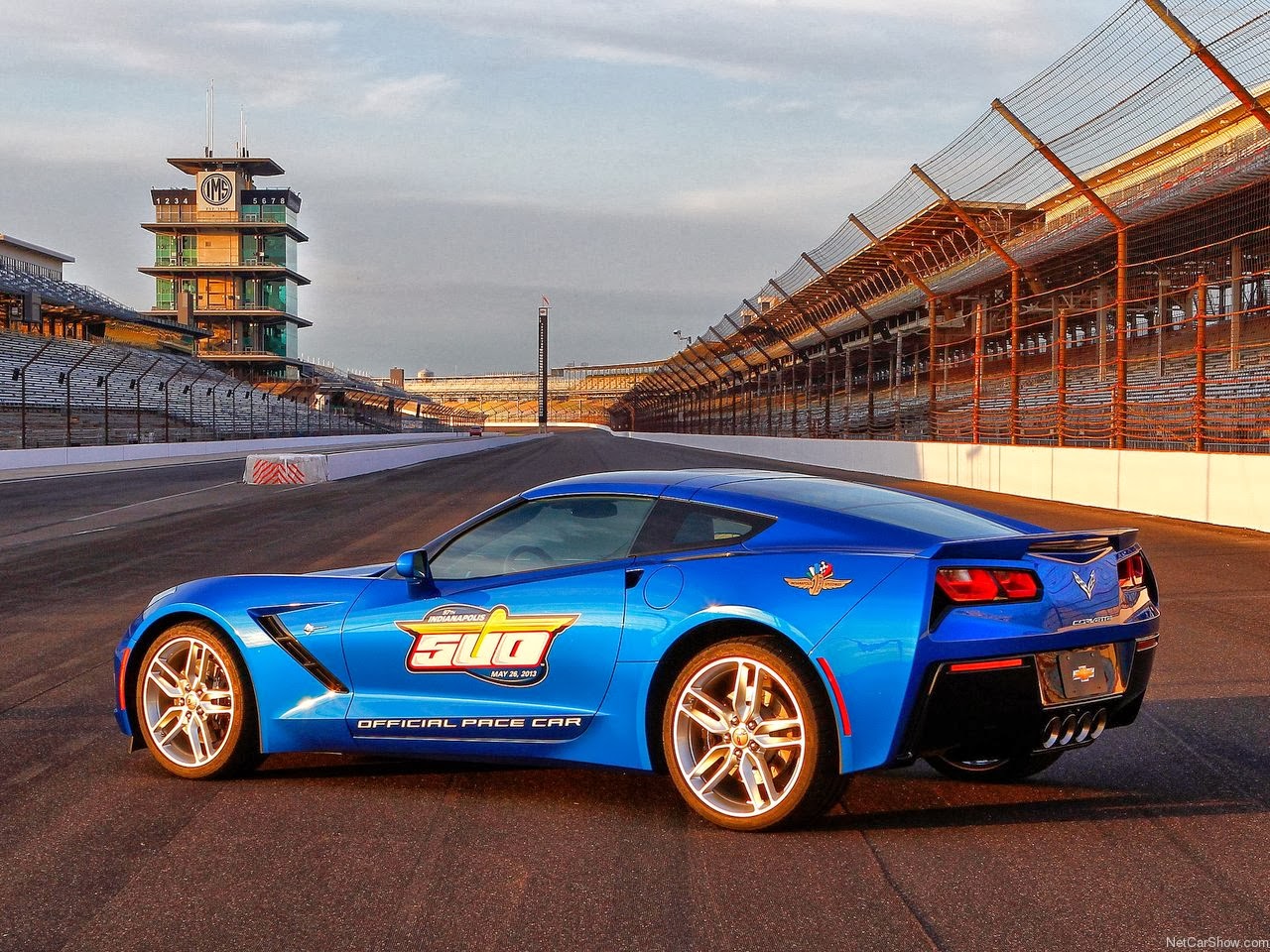
The all-new, seventh-generation 2014 Corvette Stingray will serve as the Indianapolis 500 Pace Car, leading the field to green at the start of the 97th running of "The Greatest Spectacle in Racing," on Sunday, May 26, 2013, at Indianapolis Motor Speedway.
It marks a record 12th time the Corvette has served as the Pace Car, starting in 1978.
"It is an honor to help inaugurate the all-new Corvette Stingray at the hallowed Brickyard and further the legacy between Chevrolet and the Indianapolis 500," said Jim Campbell, GM vice president of Performance Vehicles and Motorsports. "The 2014 Corvette Stingray's performance was influenced by racing, making this prestigious assignment even more fitting."
 long with Chevrolet's return in 2012 as an engine supplier, the Corvette Stingray Pace Car extends a legacy at the Brickyard that dates to the racetrack's early days.
"Chevrolet is a great partner of the Speedway," said Jeff Belskus, Indianapolis Motor Speedway Corporation president and chief executive officer. "That connection is heightened this year with the next-generation Corvette in front of a very talented field of racers."
Decked out in Laguna Blue Tintcoat with official Indianapolis 500 graphics on the doors, the Corvette Stingray Pace Car differs from production models with only track-mandated safety features and strobe lights. No powertrain upgrades are required to run in front of the IndyCar pack, thanks to its all-new 6.2L LT1 engine, which features advanced technologies including direct fuel injection, continuously variable valve timing and Active Fuel Management (cylinder deactivation). They help produce an estimated 450 horsepower more efficiently.

  • An interior that offers genuine carbon fiber and aluminum trim, hand-wrapped leather materials, dual eight-inch configurable driver/infotainment screens, and two new seat choices - each featuring a lightweight magnesium frame for exceptional support
  • Advanced driver technologies, including a five-position Drive Mode Selector that tailors 12 vehicle attributes to fit the driver's environment and a new seven-speed manual transmission with Active Rev Matching that anticipates gear selections and matches engine speed for perfect shifts every time
  • Lightweight materials, including a carbon fiber hood and removable carbon fiber roof panel on coupes; composite fenders, doors and rear quarter panels; carbon-nano composite underbody panels and a new aluminum frame help shift weight rearward for an optimal 50/50 weight balance that supports a world-class power-to-weight ratio
  • A sculpted exterior featuring advanced high-intensity discharge and light-emitting diode lighting and racing-proven aerodynamics that balance low drag for efficiency and performance elements for improved stability and track capability
  • Track-oriented Z51 Performance Package, including an electronic limited-slip differential; dry-sump oiling system; integral brake, differential and transmission cooling; as well as a unique aero package that further improves high-speed stability.

Saturday, 12 October 2013

Cadillac STS

Cadillac STS

Origins

The STS was the successor to the Cadillac Seville. That car used the STS name, standing for Seville Touring Sedan on upscale performance-oriented versions beginning in 1988. In 1992, Cadillac split the Seville line into STS and less performance-oriented SLS (for Seville Luxury Sedan) trim lines. The next year, the STS received Cadillac's then-new Northstar System, including the aluminium DOHC L37 Northstar V8 engine. Throughout its existence, the STS was Cadillac's highest-priced sedan. Worldwide, the STS was Cadillac's flagship model. In the United States and Canada, the STS in its day was positioned between the smaller mid-size CTS and larger full-size DTS, but was priced above the latter.


The front wheel drive Seville was retired in 2004, replaced by an entirely new STS model based on the rear wheel drive GM Sigma platform. All wheel drive is offered as an option, the first Cadillac sedan to be available with this drive system. The STS carries on the Magnetic Ride Control suspension, which has bragging rights as being the 'fastest reacting suspension ever,' before it was ever utilized on newer Corvettes and Ferraris.
The Cadillac STS was assembled at GM's Lansing Grand River facility in Lansing, Michigan along with the smaller Cadillac CTS sedan.
Available engines were a 3.6 L High Feature LY7 V6 with 255 hp (190 kW) and 252 lb·ft (342 N·m) and the 4.6 L Northstar LH2 V8 which puts out 320 hp (240 kW) and 315 lb·ft (427 N·m) in the STS. All engine models feature dual overhead camshafts with VVT. Remote ignition is standard. Although most 2005 and 2006 Cadillac STS models offer a 255 hp (190 kW) engine, an option for a 4.6 L 320 hp (239 kW) engine was available at the time through Cadillac's performance packages. As of 2007, Cadillac now has different packages and car models, which no longer support this option.
Wheelbase was 116.4 in (2,957 mm), though overall length was shorter than the Seville. Interior space was greater than its predecessor. A heads-up display was optional, as was a 300-watt Bose stereo system with MP3 capability. Base pricing started at US$40,995 (slightly higher than the DTS, which was longer but had front-wheel drive), and extended to US$52,240 for the AWD V8 model.

For the 2007 model year, the Chinese market received the Cadillac SLS. Compared to the STS, the SLS has a longer wheelbase, unique interior appointments, and a near-identical exterior appearance. Engine choices are the 2.8-liter V-6, 3.6-liter V-6 (the non-direct-injection version shared with the 2005-2007 STS V-6), and the same 4.6-liter Northstar V-8 as in the STS V-8.
The Chinese-Spec SLS received a facelift at the end of 2009, and was sold as a 2010. The grill, bumper and many other details were revised. Shanghai-GM also introduced the OnStar system to the model. Two SIDI engines were introduced, a 272 hp 3.0L and a 310 hp 3.6L. The SLS is priced from 448,000RMB to 698,000RMB.
 For 2008, the STS was updated. Changes included a refreshed exterior, with styling cues resembling the 2008 CTS, such as larger, more aggressive grille and chrome fender vents. The interior was updated, with new materials and a new steering wheel, though the overall interior design remained the same, despite previous rumors of an all-new interior similar to that of the Chinese-market SLS. The standard powertrain was a direct-injected 3.6 L V6 mated to a six-speed automatic transmission, which in the STS produced 302 horsepower (225 kW) and 272 lb·ft (369 N·m) of torque. It also offered enhanced safety features, including a lane departure warning system developed by Mobileye, a blind spot monitoring system, and an improved version of GM's StabiliTrak stability control system, which could operate the steering system in addition to the brakes to help correct a skid. Additionally, options previously limited to the V8 model (such as HID headlamps and heads-up display) were available with the V6. The 2008 Cadillac STS debuted at the 2007 New York Auto Show.


  • 3,564 cc 3.6 liters V 6 front engine with 94 mm bore, 85.6 mm stroke, 10.2 compression ratio, double overhead cam, variable valve timing/camshaft and four valves per cylinder LY7
  • Unleaded fuel 87
  • Fuel consumption: EPA urban (mpg): 17, country/highway (mpg): 25 and combined (mpg): 20
  • Fuel economy EPA highway (mpg): 25 and EPA city (mpg): 17
  • Multi-point injection fuel system
  • 17 gallon main unleaded fuel tank
  • Power: 190 kW , 255 HP SAE @ 6,500 rpm; 252 ft lb , 342 Nm @ 2,800 rpm


Popular Posts